MBTI vs Big Five
The four-letter test — the 16 personalities
— is the most popular in the world. And yet serious psychology doesn’t use it. This is the difference, without caricature and without flattery.
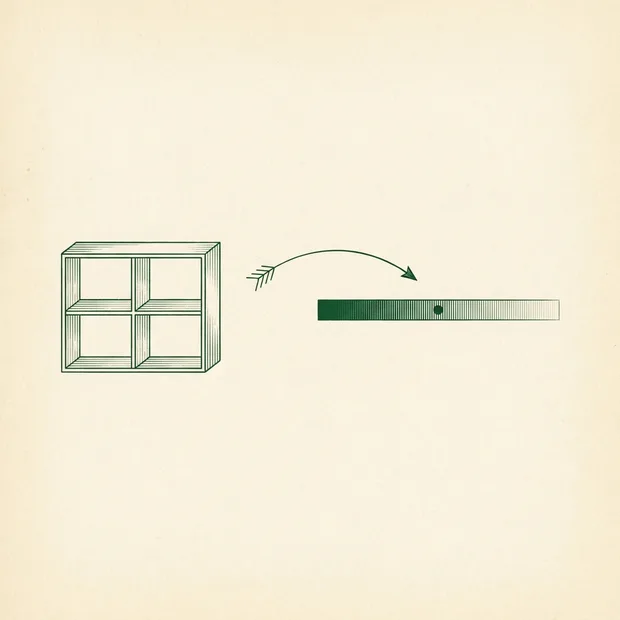
Almost everyone knows their four-letter type: INTJ, ENFP, whichever. The MBTI — and its most widespread free version, the 16 personalities
test — has achieved something extraordinary: millions of people carry a personality label in their head. The problem isn’t that it’s popular. It’s that the label promises more than it can deliver.
What the MBTI is (and where it comes from)
The MBTI was born in the mid-twentieth century from Katharine Cook Briggs and her daughter Isabel Briggs Myers, inspired by the typology of psychiatrist Carl Jung. It classifies you by combining four opposing pairs: introversion or extraversion, sensing or intuition, thinking or feeling, judging or perceiving. Four binary decisions, two to the n: sixteen types. Clean, memorable, shareable. Which is why it works so well as a group identity.
The three serious grievances
One: it cuts a continuum in half. It declares you introvert
or extrovert
, but sociability doesn’t come in two flavours: most people sit somewhere in between. Cutting right down the middle turns two nearly identical people into different types
, and sends someone on the edge to one side or the other depending on the day.
Two: it changes too much on a retake. A reliable measure should give you nearly the same answer twice. With the MBTI, a considerable share of people who retake it a few weeks later come out a different type. If your type
depends on the morning you had, it isn’t measuring much.
Three: beyond the test itself, it predicts little. Knowing your four letters barely anticipates how you’ll perform at a job, handle stress, or fare in a relationship. A personality measure that matters should say something about real life, not just about itself.
What makes the Big Five different
The Big Five (OCEAN) wasn’t invented in an office: it emerged from the data. When you analyse the thousands of words we use to describe people, the traits cluster again and again into five axes — openness, conscientiousness, extraversion, agreeableness and emotional stability. Those five repeat across cultures, stay reasonably stable through adult life, and relate, modestly but reliably, to real things.
And the deeper difference: the Big Five doesn’t put you in a box. It places you at a point on each axis. You aren’t the open type
; you are this open, on a scale, with your nuance. One of its strengths is exactly what the MBTI lacks: the fifth axis, emotional stability, which the type model doesn’t even look at.
Being fair: what the MBTI is good for
It isn’t all grievance. The MBTI offers a shared vocabulary for talking about differences — and in a team or a couple, that’s worth something. It works as a starting point for self-reflection and as conversation. The mistake isn’t playing with it; it’s confusing a parlour game with a measurement and making serious decisions — hiring, matching, steering a career — on four letters.
In one sentence:
The MBTI gives you an identity; the Big Five gives you a measure. One entertains you and joins you to a tribe; the other describes you — even when it doesn’t flatter you.
Frequently asked questions
Is the MBTI scientific?
Not in the sense people assume. Academic psychology doesn't use it as a personality measure: its retest reliability is low (many people come out a different type a few weeks later) and it predicts little beyond the questionnaire itself. As a shared language or a self-reflection game it's entertaining; as measurement, it isn't.
Do the MBTI and the Big Five measure the same thing?
They overlap halfway: introversion–extraversion matches Big Five extraversion, sensing–intuition resembles openness, thinking–feeling maps to agreeableness, and judging–perceiving to conscientiousness. But the Big Five adds a fifth axis the MBTI ignores — emotional stability (neuroticism) — and it measures in degrees, not closed types.
Why does the MBTI seem to nail me so well?
The Forer (or Barnum) effect: descriptions flattering and general enough that almost anyone recognises themselves. They feel personal precisely because they work on everyone.
Which one should I use?
For chatting or passing the time, the MBTI does the job. For genuinely understanding yourself — or any decision that matters — the Big Five: it's dimensional, replicates across cultures, and relates, modestly but reliably, to real outcomes.
Where can I measure my Big Five for free?
At Lucid Prism, with a public-domain instrument (IPIP) and no flattery. It takes minutes, and you leave with your profile in five dimensions.
Measure yourself with the Big Five
No types, no flattery: your profile on the five dimensions science actually uses, in minutes, free. A mirror, not a compliment.
Find your archetype →Want the foundation? What the Big Five is →